Moreover, phrasal verbs can be intransitive -- not followed by a direct object – or transitive – followed by a direct object. Therefore, phrasal verbs can be separable, inseparable, transitive or intransitive . Each of the following sentences uses a phrasal verb. Read each sentence carefully and figure out exactly what the sentence is trying to say. Often, phrasal verbs have different meanings than a verb being modified by adverbs or prepositional phrases.
You may also notice that some of these phrasal verbs can be separated out and the sentence will still make sense. (They looked them over carefully.)look upsearch in a listYou've misspelled this word again. She picked out the guy she thought had stolen her purse.pick uplift something off something elseThe crane picked up the entire house. (Watch them pick it up.)point outcall attention toAs we drove through Paris, Francoise pointed out the major historical sites.put awaysave or storeWe put away money for our retirement. She put away the cereal boxes.put offpostponeWe asked the boss to put off the meeting until tomorrow. (Please put it off for another day.)put onput clothing on the bodyI put on a sweater and a jacket.

Move Up Phrasal Verb Examples (I put them on quickly.)put outextinguishThe firefighters put out the house fire before it could spread. (They put it out quickly.)read overperuseI read over the homework, but couldn't make any sense of it.set upto arrange, beginMy wife set up the living room exactly the way she wanted it. She set it up.take downmake a written noteThese are your instructions. Write them down before you forget.take offremove clothingIt was so hot that I had to take off my shirt.talk overdiscussWe have serious problems here.

Let's talk them over like adults.throw awaydiscardThat's a lot of money! It really turned me off.turn onswitch on the electricityTurn on the CD player so we can dance.use upexhaust, use completelyThe gang members used up all the money and went out to rob some more banks. Multi-word verbs are verbs that combine with one or two particles, which may be adverbs or prepositions, to make new verbs.

A lot of common verbs do this and many of them can combine with several different particles. Separable phrasal verbs follow different rules, however. For starters, separable phrasal verbs are always transitive, so they always have a direct object.

This article describes the various ways in which the Macmillan Phrasal Verbs Plus dictionary deals with pronunciation and stress. It also explains some simple rules that will help you to pronounce phrasal verbs confidently when they form part of a sentence. Be consistent and systematic – as with anything else you want to teach, you cannot expect students to learn something the first time you teach it. If students have no difficulty in understanding and using the verb get up, for example, this is probably due to the fact that this verb has occurred several times in course books for many years. Try to include phrasal verbs, either formally or informally, in every lesson you teach.
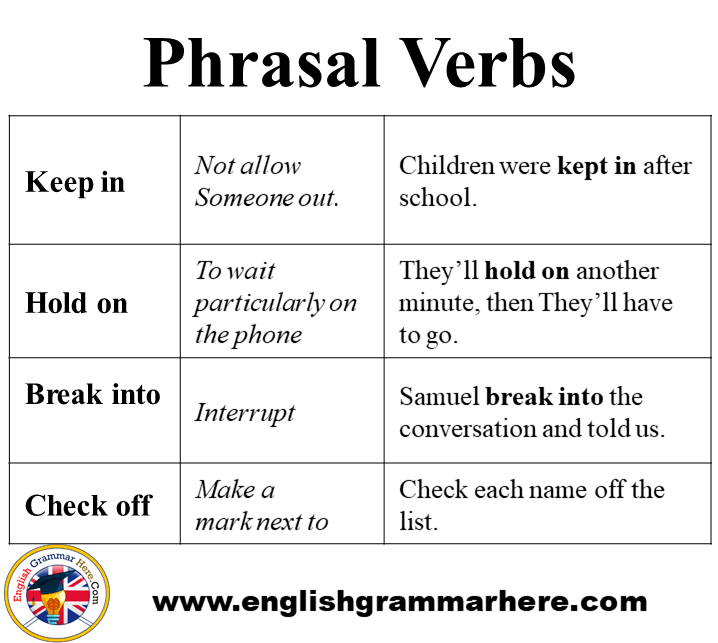
For many students, one of the most difficult parts of learning English is studying phrasal verbs. A phrasal verb is a verb that is combined with an adverb or preposition. The combination creates a new meaning, often one that is not related to the definition of the base verb and is difficult to guess. The problem with phrasal verbs lies in their second element which is, for reasons that I do not find very clear, most of the times called a PARTICLE. According to some, a particle can be either a preposition or an adverb.
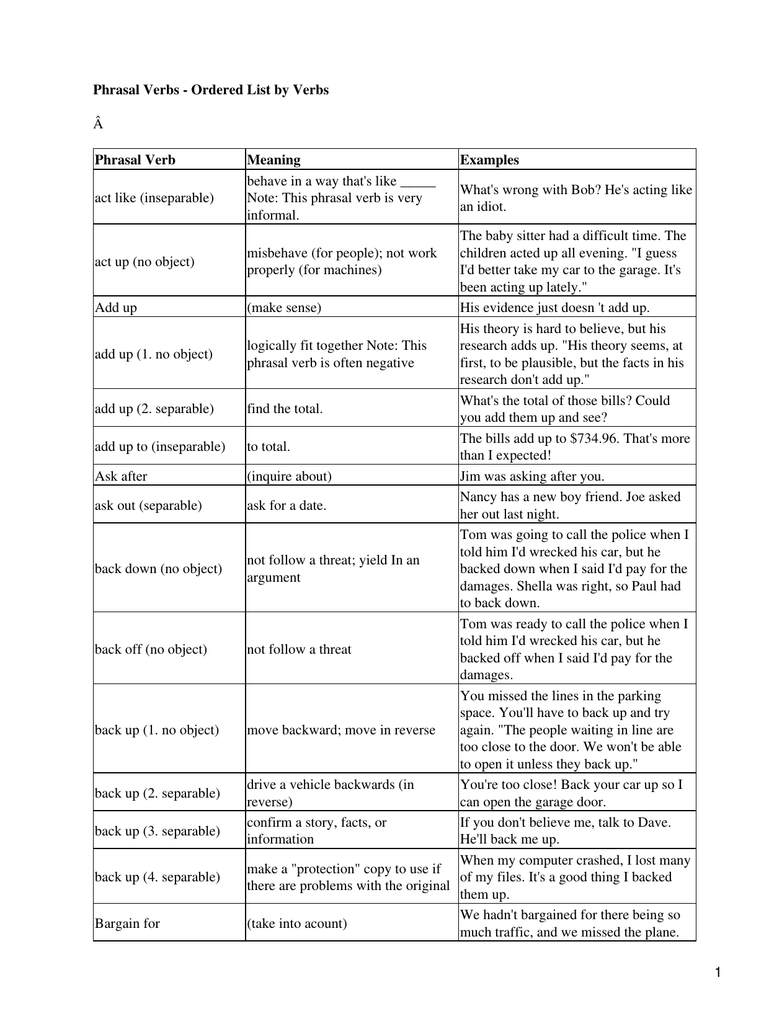
If we believe others, it can only be an adverb (The verb+ preposition compounds are then simply called prepositional verbs). Here is an alphabetical list of frequently used phrasal verbs with definitions and examples. In cases where the phrasal verb can be either separated or used as a single unit, examples are given of both forms. Remember that phrasal verbs can be either separable or inseparable .

Each phrasal verb is also marked as separable or inseparable . In the case that verbs are separable, examples will use the separable form of the phrasal verb. For inseparable phrasal verbs, examples keep the phrasal verbs together.

Sometimes the object of a transitive phrasal verb must be placed between the verb and particle. Phrasal verbs which must take an object are known as transitive phrasal verbs. In the examples below the object must go after the verb and particle. The fact is that memorising the various meanings that particles can assume can prove to be as time consuming and ineffective as trying to memorise the meanings of phrasal verbs.
Phrasal verbs have always been common, but have increased in number since the mid-19c and even more so since the mid-20c, especially in AmE. As a result, a number of dictionaries of phrasal verbs have been published since 1974 and increasingly dictionaries for both native and foreign users have given phrasal verbs main-entry or high secondary status. They are increasingly the subject of special attention in courses for foreign learners of English, and it was in this area that the category came of age as a distinct aspect of grammar, word-formation, and usage. The same is true for phrasal verbs, and Macmillan Phrasal Verbs Plus includes many nouns and adjectives that are formed from phrasal verbs. These are shown at the end of a phrasal verb entry.

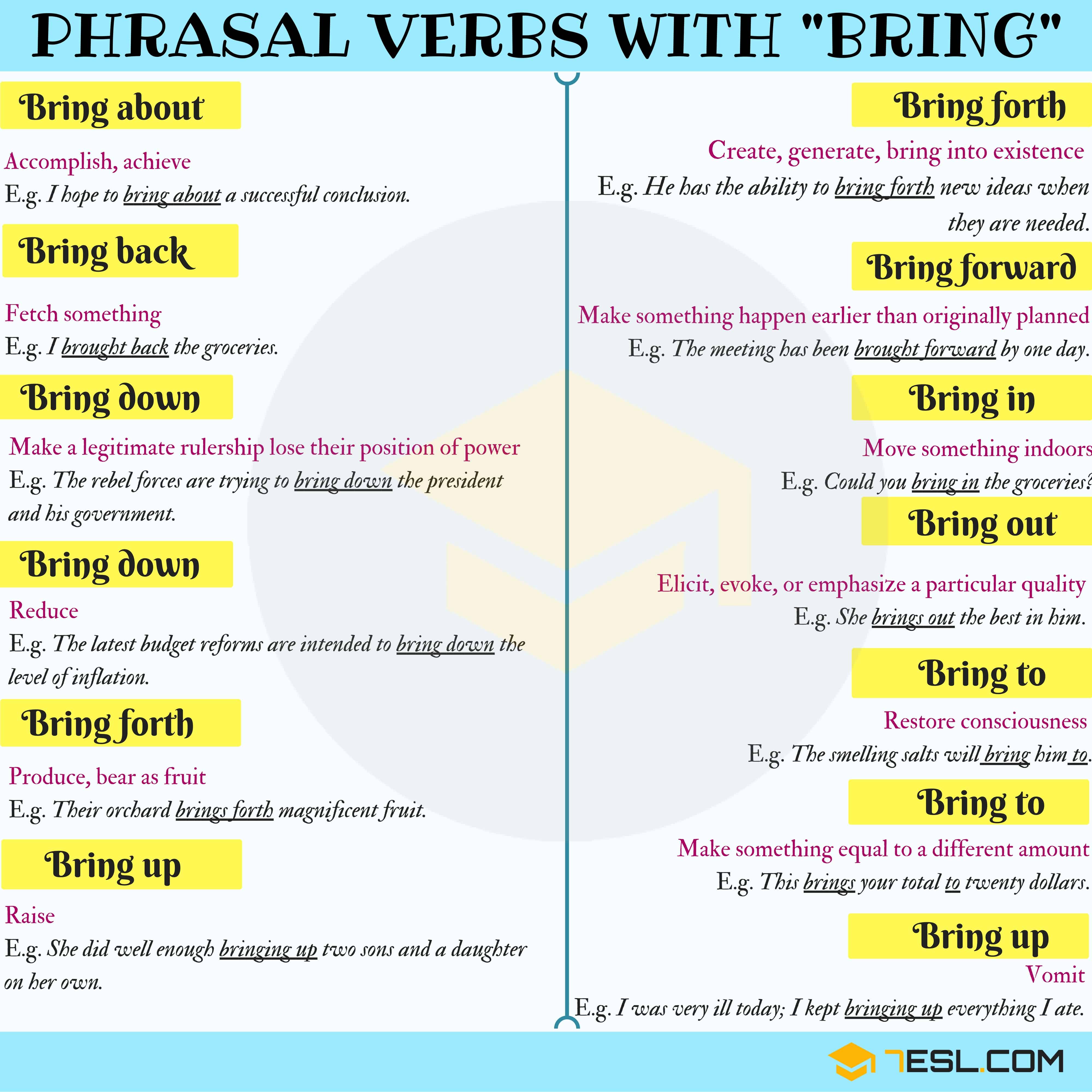
For example, the entry for the verb black out also shows the related noun blackout. The term citation form refers to the pronunciation and stress pattern that is shown in a dictionary entry. This information is accurate when the phrasal verb is spoken in isolation, and even when a phrasal verb is used in context, it is still likely to follow the stress pattern of its citation form. But it is also possible that in connected speech the speaker may choose to place the stress differently in order to convey a particular meaning.

In such cases the normal rules of stress shift apply. In a more meaning-focused approach, phrasal verbs can be presented and practised according to a topic. For example, in the topic family, verbs such as look like, get on with, bring up and grow up would be quite frequent. Another frequent type of exercise is to present a single verb, for example, look, combined with different particles, for example, after, down on, for, and so forth. Even though phrasal verbs are treated as a single unit, it is possible to separate out the words of some phrasal verbs. For example, the sentences I have to knock down all of the bowling pins and I have to knock all of the bowling pins down have the same meaning and are both grammatically correct.
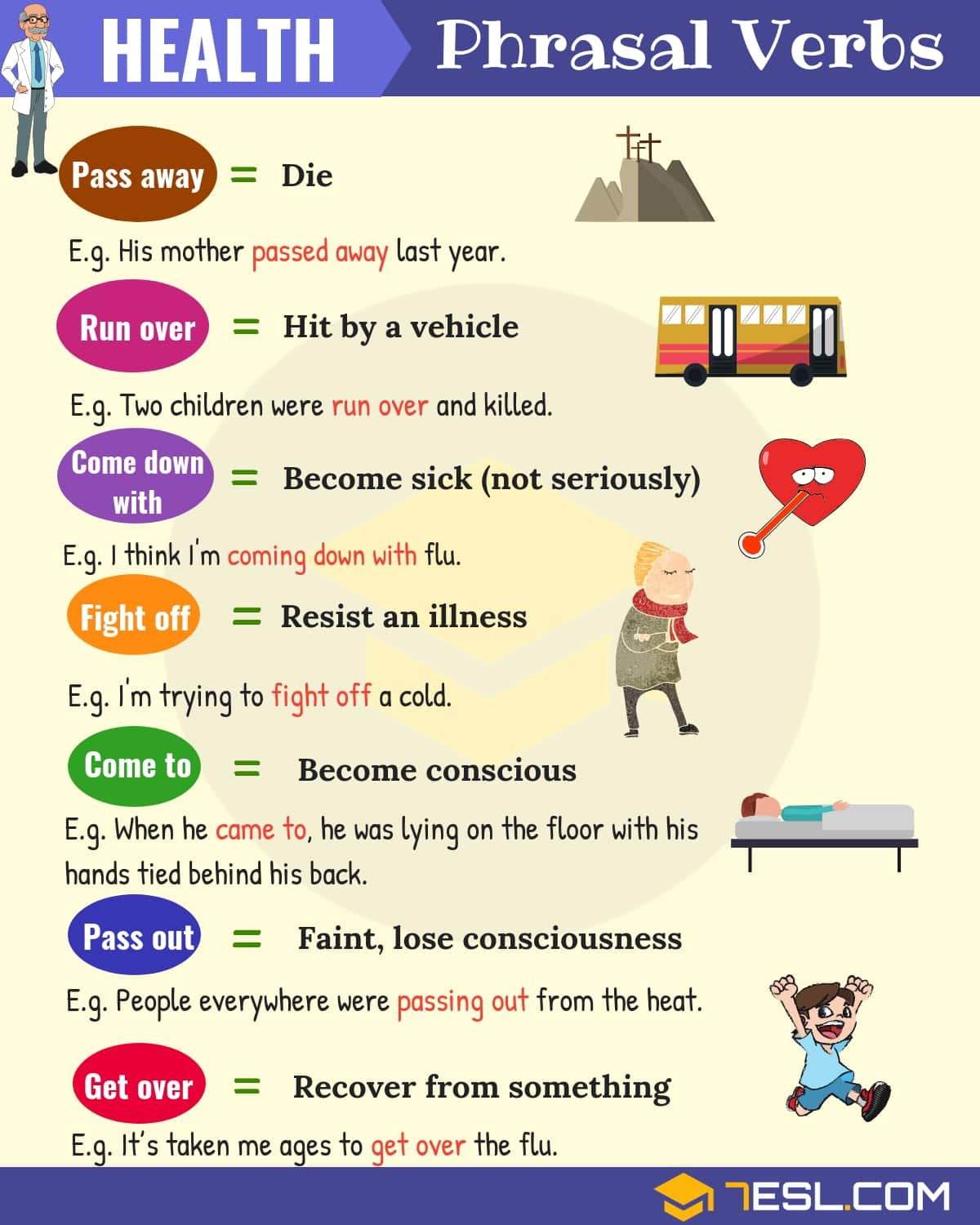
However, not every phrasal verb can be separated like this. For example, we can say I came across some old photos but we wouldn't say I came some old photos across. The main pronunciation question with phrasal verbs concerns the placement and distribution of stress on the verb, the particle and the other words in the sentence. Phrasal verbs (also known as multi-word verbs) are verbs made of two or more words. The first word is a verb and the second word is either a preposition or an adverb. Now let's analyse a few phrasal verbs with more idiomatic meanings and the conceptual metaphors that motivate them.

A phrasal verb can be a regular verb or an irregular verb, so make sure to conjugate the verb correctly. It can be used in any of the 12 verb tenses, can use the passive voice, and can be used in different moods. This means that you may see phrasal verbs accompanied by linking verbs. Most phrasal verbs are used as action verbs, so it is also possible that they may use direct objects. Although this sounds tough, phrasal verbs are not hard to use if you have mastered all of the other types of verbs.

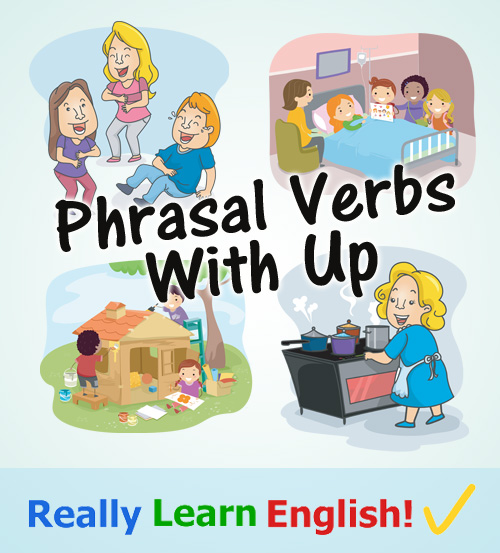
Here, we're going to look at phrasal verbs that include the preposition "up." "Up" often has one of the meanings described below. Not all phrasal verbs with "up" fall into these categories, but there are many examples that do. Now you know more about transitive and intransitive verbs, start paying attention to them when you study. When you meet a new phrasal verb, make a note of whether it's transitive or intransitive so you know if you can separate the verb or not. And make your own examples too to help you remember them more easily.
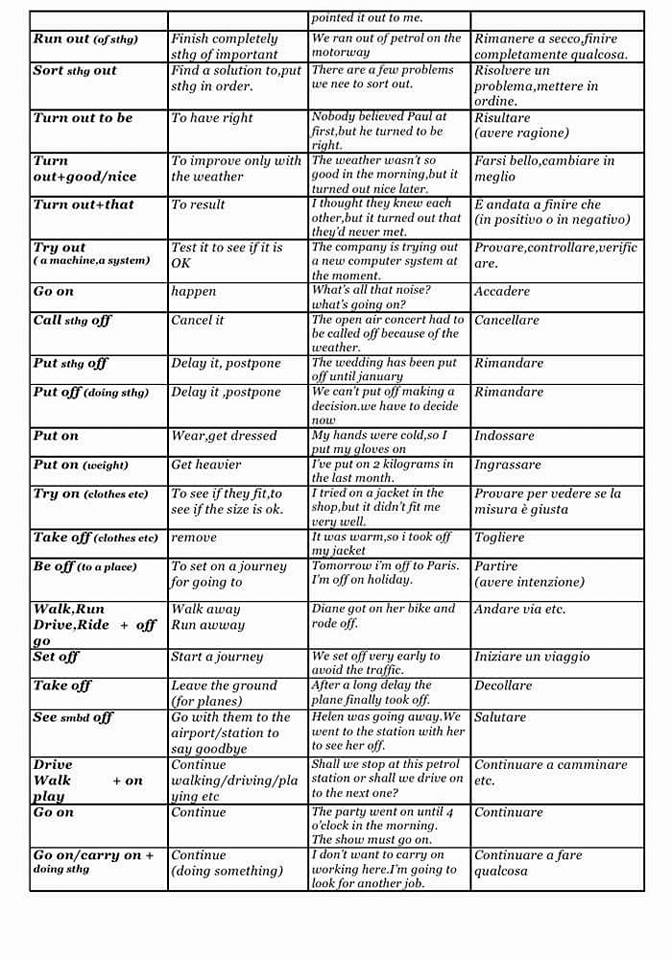
In all these combinations, the added semantic value, if any, derives from metaphoric or metonymic interpretation of the complement, not from the preposition. At best, they can be described as "verbal phrases", but certainly not as "phrasal verbs" like e.g., PUT UP in Yes, they could put up an itinerant poet for a few days (W. Boyd A Good Man in Africa, 1981). Luckily for us the good people at PHaVE Dictionary already thought of this and made a list of the 150 most common phrasal verbs and their most common meanings using various corpora . The meaning of the phrasal verbs is often very different from the meanings of the two words taken separately. In order to understand the meaning of a phrasal verb, you may have to refer to the dictionary. As you learn new phrasal verbs, think about how YOU would use them.

Write phrases or sentences you may use in the future that use those phrasal verbs, and review them regularly. Just a couple minutes of reviewing your list each day can make a big difference in your ability to use those terms while you're speaking. Up." There are, however, a few rules to follow with separable phrasal verbs, so pay attention to our next section about word order. The general feeling, one that you might have experienced as an EFL student, or a teacher, is that phrasal verbs are fairly illogical, as mentioned before, and that their meanings happen by chance. However, research has shown that, far from being arbitrary, phrasal verbs follow certain patterns and when a new combination between a verb and a particle happens, it will fit this pattern.

This explains why new phrasal verbs are created and how they quickly become part of the language. As a student of English, some of the things you need to learn are phrasal verbs. And when you learn them, it's very helpful to know if they are transitive or intransitive.

Reading to these phrasal verbs, or any piece of vocabulary for that matter, is only the first step to learning them. Here are six things you can do today to help you remember the 10 most common phrasal verbs. Norbert Schmitt and Mélodie Garnier are language experts.

They developed a list which ranks the most common phrasal verbs. The following is a list of commonly deployed phrasal verbs that find one use or another in academic texts. These can be acceptably used in academic texts. Along with these examples, however, are a number of one-word substitutions to illustrate that in each case the phrasal verb can be easily replaced. To help simplify this complicated issue, what follows is our guide to understanding English phrasal verbs, including a list of the most common ones.

These phrasal verbs have both a primary and a secondary stress. The primary stress is on the second word, the particle. The secondary stress is on the first word, the verb.

The main thing to be careful of when using phrasal verbs is if a phrasal verb can be separated out or not. If you want to be on the safe side, you can simply avoid separating out any phrasal verb until you know for sure which ones can be separated out and which cannot. The definitions of many phrasal verbs need to be memorized. There are hundreds of phrasal verbs in English, and this can be overwhelming for students. However, you will be pleased to know that there are often patterns in how phrasal verbs are formed. So, if these challenges make you want to avoid using phrasal verbs when you speak, that's completely understandable!

The tips and resources below can help you start becoming more skillful and confident with your use of phrasal verbs. Phrasal verbs are incredibly common in English, especially in spoken English. You need to know common phrasal verbs to help you understand what people are saying and to help people understand you.

You've probably noticed that they don't always appear this way, though. Some phrasal verbs can be separated and allow other words to appear between the parts, while others are non-separable and need to stay together. In the first sentence, the main verb is "run," and the phrase "up the hill" describes where they ran. In the second sentence, the phrasal verb "run up" is used. Inseparable phrasal verbs cannot be split up and must be used together. A phrasal verb is a combination of words (a verb + a preposition or verb +adverb) that when used together, usually take on a different meaning to that of the original verb.

You can add a preposition so that the Type 3 verb can have an object. They have an adverb and a preposition followed by a direct object. You can't separate the parts of the phrasal verb. The student is given a series of verbs, usually in a sentence, and they have to supply the correct particle.
Sometimes the particles are given and the student has to complete the sentence by forming the correct phrasal verb. The following list contains just some of the many phrasal verbs that we use in sentences and clauses. Unfortunately, there is no general rule that determines which phrasal verbs can and can't be separated. You'll need to learn which phrasal verbs can be split apart as you find them. If one admits that there is a separability issue, I suggest the question be reversed.

I propose to consider that phrasal verbs evolve from an original separate stage, through a non-separate one, to eventually become unseparable combinations, not the other way round. They are also essential if you want to be fluent and sound native like. But with thousands of phrasal verbs out there, many with multiple meanings, it's virtually impossible to remember them all. Over time, you will slowly build up a set of many phrasal verbs that you can understand and use. But you can make the learning process easier by studying and using small numbers of them at a time.

Today, we will explore two common phrasal verbs. They both have the verb "come." They are come back and come up. We talked about some of the most common phrasal verbs in another Everyday Grammar program.
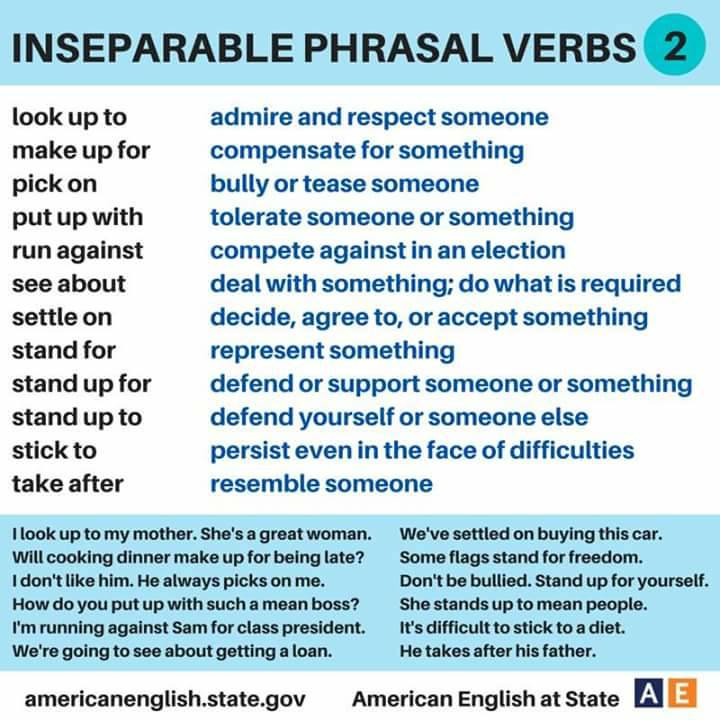
When used together, the verbs and particles have an idiomatic meaning. In other words, the phrasal verb means something other than what the individual words suggest. On the other hand, sometimes it doesn't matter whether the direct object comes in the middle or at the end of a phrasal verb. Unfortunately, there's no method for knowing whether or not you have to separate a phrasal verb; you just have to study and practice until it comes naturally.



No comments:
Post a Comment
Note: Only a member of this blog may post a comment.